Part I · Foundations and the four financial statements · Chapter 2
The Balance Sheet
قائمة المركز المالي (الميزانية العمومية)
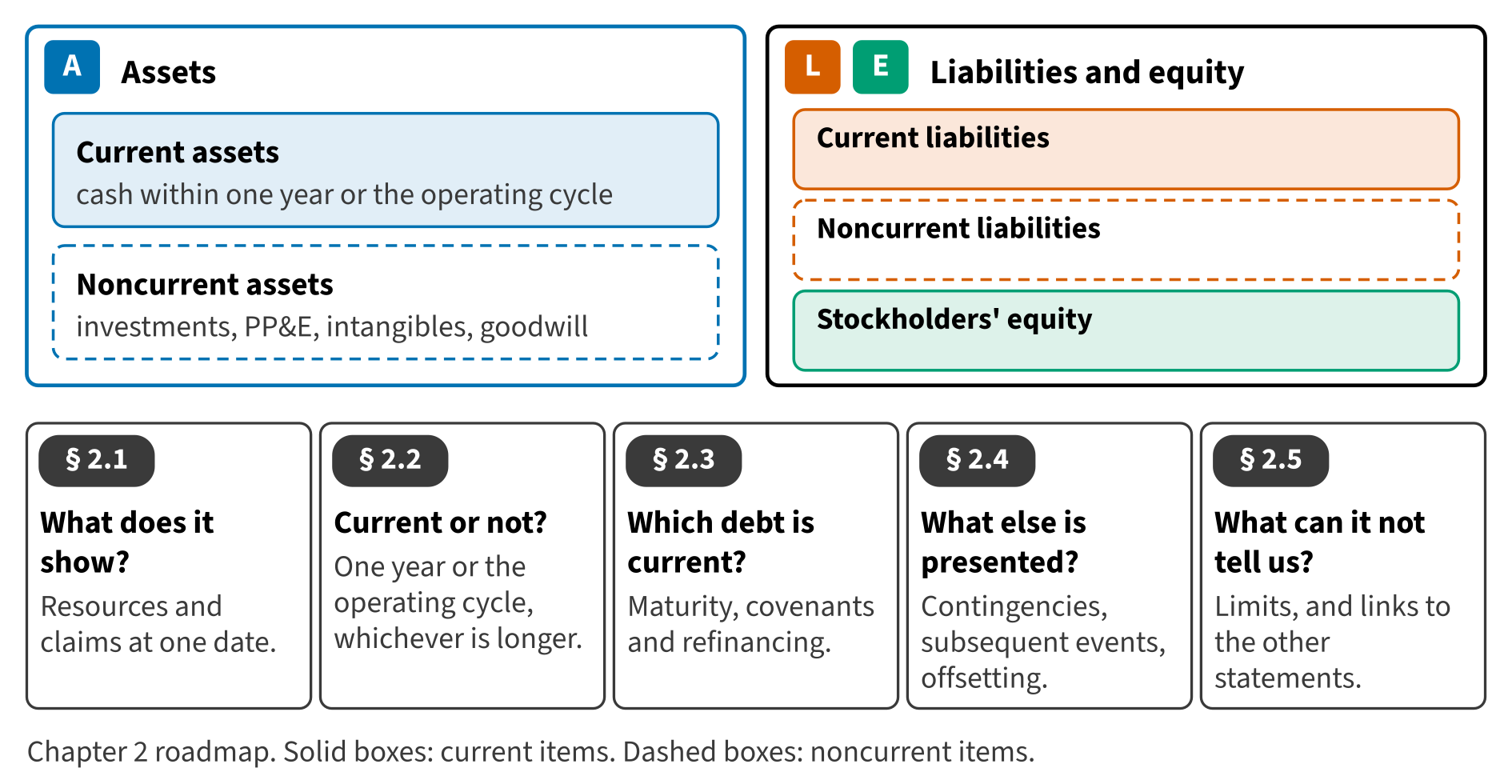
In Chapter 1 you learned the accounting equation and saw Barada Wholesale's trial balance. Now we turn a full set of accounts into the first of the four statements: the balance sheet. It is a picture of the company on one day. It shows what the company controls, what it owes, and what belongs to its owners.
Start here
Then
What this chapter is tested on
| LOS | Official statement (ICMA, 2024) | In plain words | Depth here |
|---|---|---|---|
| A.1.b | demonstrate an understanding of the purposes and uses of each statement | Explain the purpose of the balance sheet and how users apply it to judge liquidity, solvency and financial flexibility. | Full treatment (balance sheet) |
| A.1.c | identify the major components and classifications of each statement | Identify the major components and classifications of a classified balance sheet, including debt classification. | Full treatment (balance sheet) |
| A.1.d | identify the limitations of each financial statement | Identify the limitations of the balance sheet. | Full treatment (balance sheet) |
| A.1.f | demonstrate an understanding of the relationship among the financial statements | Show how the balance sheet links to the other three statements. | Introduced (full in Chapter 5) |
| A.2.ff | identify and describe the following differences between U.S. GAAP and IFRS: (i) expense recognition, with respect to share-based payments and employee benefits; (ii) intangible assets, with respect to development costs and revaluation; (iii) inventories, with respect to costing methods, valuation, and write-downs (e.g., LIFO); (iv) leases, with respect to lessee operating and finance leases; (v) long-lived assets, with respect to revaluation, depreciation, and capitalization of borrowing costs; and (vi) impairment of assets, with respect to determination, calculation, and reversal of loss | State the IFRS differences in debt classification. | Preview (full in Chapter 17) |
The official statements are quoted from the ICMA Learning Outcome Statements (effective September 1, 2024). The plain-words column restates them in simpler English. The exam may test any outcome up to Level C.
What you already know
Under IFRS you call it the statement of financial position, and many IFRS balance sheets put noncurrent assets first. U.S. companies usually start with current assets and list them in order of liquidity: cash first. The rules for classifying debt are also different, as Section 2.3 shows.
The 10 key terms
Every scene has Check Answers and Try Again. Try Again reshuffles rather than revealing. When you are wrong, the first thing you read is the reason for the option you chose, taken from the book's own explanations. Progress is saved in this browser.