Part III · Revenue, liabilities and income measurement · Chapter 14
Leases
عقود الإيجار
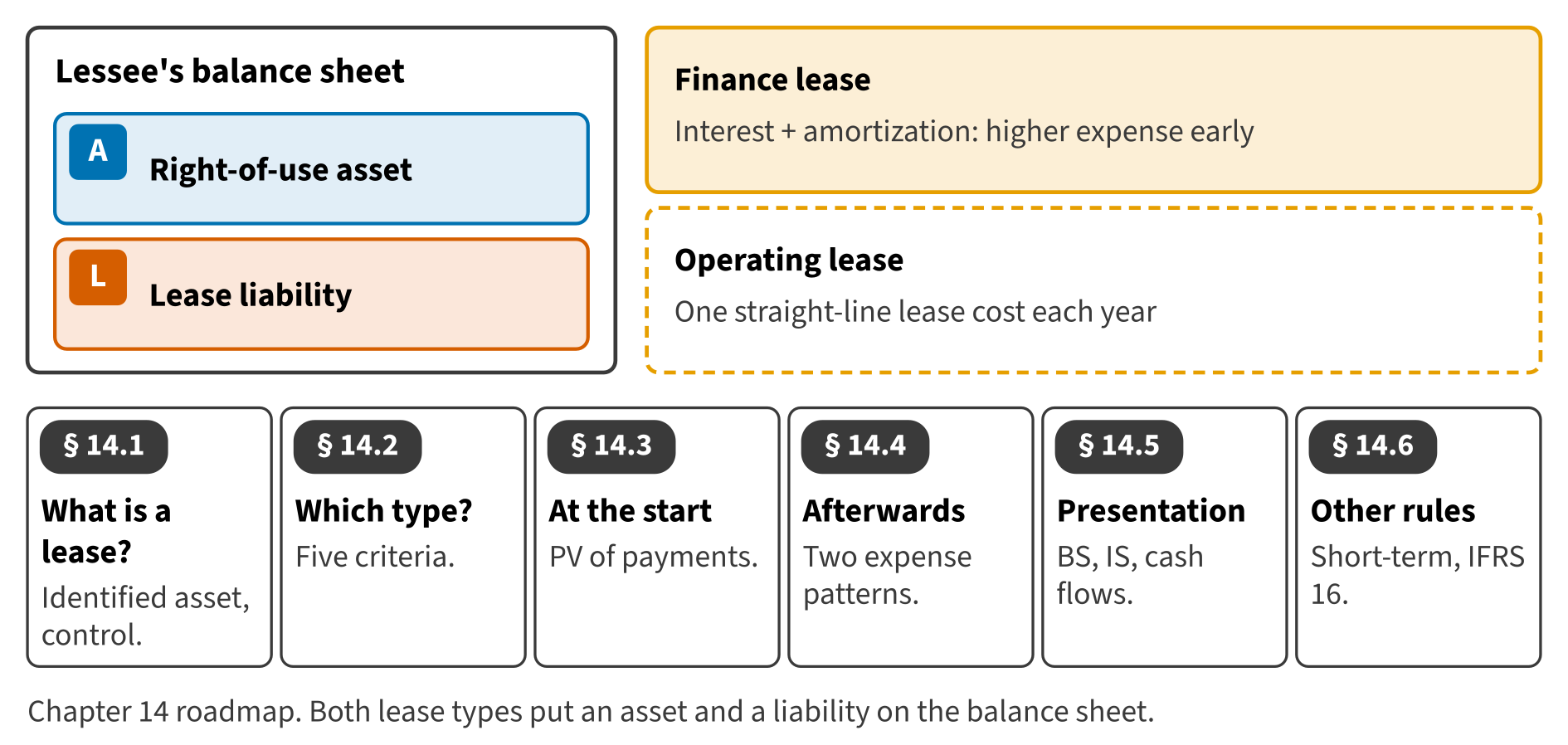
Many companies use buildings, machines and vehicles that they do not own. Before 2019, most of these leases were hidden in the notes. Today a lessee reports almost every lease on its balance sheet. This chapter explains how.
Start here
Then
What this chapter is tested on
| LOS | Official statement (ICMA, 2024) | In plain words | Depth here |
|---|---|---|---|
| A.2.t | distinguish between operating and finance leases | Distinguish operating leases from finance leases using the five criteria. | Full treatment |
| A.2.u | recognize the correct financial statement presentation of operating and finance leases | Measure and present operating and finance leases in the lessee's statements. | Full treatment |
| A.2.ff | identify and describe the following differences between U.S. GAAP and IFRS: (i) expense recognition, with respect to share-based payments and employee benefits; (ii) intangible assets, with respect to development costs and revaluation; (iii) inventories, with respect to costing methods, valuation, and write-downs (e.g., LIFO); (iv) leases, with respect to lessee operating and finance leases; (v) long-lived assets, with respect to revaluation, depreciation, and capitalization of borrowing costs; and (vi) impairment of assets, with respect to determination, calculation, and reversal of loss | Contrast ASC 842 with the single lessee model of IFRS 16. | Preview (full in Chapter 17) |
The official statements are quoted from the ICMA Learning Outcome Statements (effective September 1, 2024). The plain-words column restates them in simpler English. The exam may test any outcome up to Level C.
What you already know
If you learned IFRS 16, you know one lessee model: every lease is like a purchase financed by a loan. U.S. GAAP keeps two models. The balance sheet looks almost the same, but the income statement and the cash flow statement can be very different.
The 8 key terms
Every scene has Check Answers and Try Again. Try Again reshuffles rather than revealing. When you are wrong, the first thing you read is the reason for the option you chose, taken from the book's own explanations. Progress is saved in this browser.