Part III · Costing systems and business processes · Chapter 13
ABC in Services and Profitability Analysis
التكاليف على أساس الأنشطة في الخدمات وتحليل الربحية
Tahini & Spreads sells to six kinds of customer, from Barada Wholesale to sixty small shops. The sales report showed a healthy gross margin on every one of them. Once the division measured what each customer costs to serve, two of them turned out to lose money.
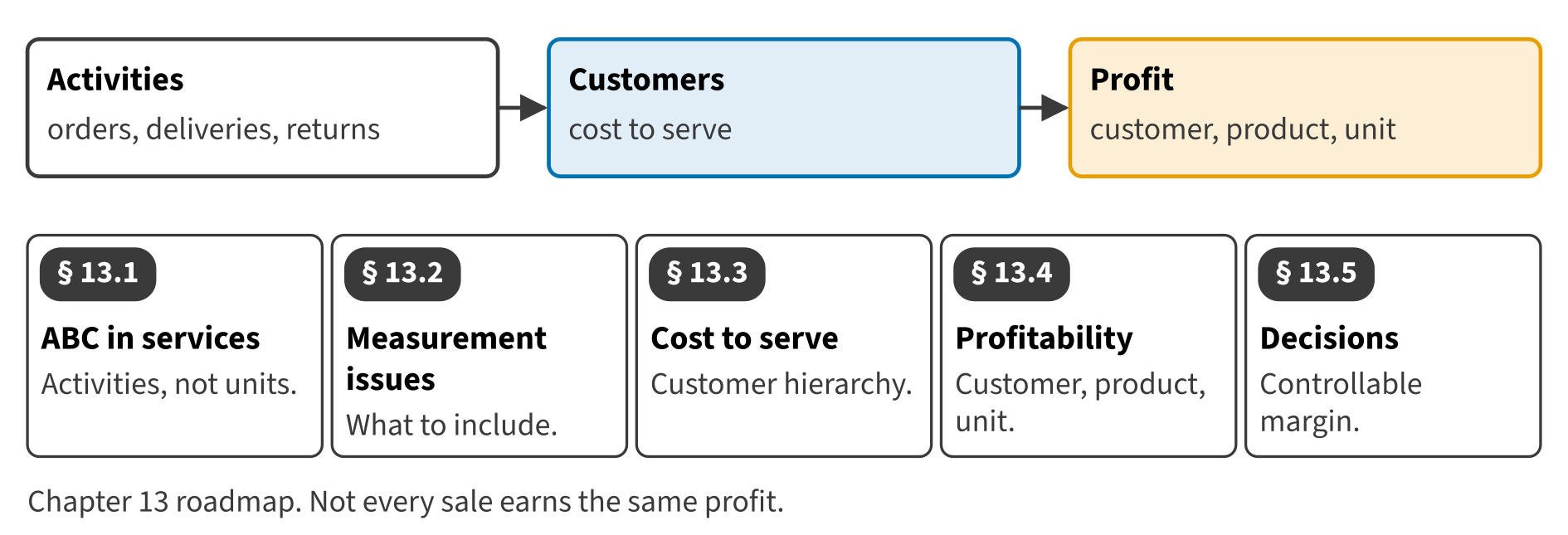
Start here
Then
What this chapter is tested on
| LOS | Official statement (ICMA, 2024) | In plain words | Depth here |
|---|---|---|---|
| D.2.i | explain how activity-based costing can be utilized in service companies | Explain how service companies use activity-based costing. | Full treatment |
| C.3.b | explain the issues involved in determining product profitability, business unit profitability, and customer profitability, including cost measurement, cost allocation, investment measurement, and valuation | Explain the measurement issues behind product, business-unit and customer profitability. | Full treatment |
| C.3.c | calculate product-line profitability, business unit profitability, and customer profitability | Calculate product-line, business-unit and customer profitability. | Full treatment + Extended Example |
| C.3.d | evaluate customers and products on the basis of controllable margin and recommend ways to improve profitability and/or drop unprofitable customers and products | Judge customers and products on controllable margin and recommend how to improve profit or what to drop. | Full treatment |
The official statements are quoted from the ICMA Learning Outcome Statements (effective September 1, 2024). The plain-words column restates them in simpler English. The exam may test any outcome up to Level C.
What you already know
Chapter 12 assigned factory overhead to products with activity rates. This chapter uses the same method for selling, delivery and service costs, and assigns them to customers instead of products.
The 7 key terms
Every scene has Check Answers and Try Again. Try Again reshuffles rather than revealing. When you are wrong, the first thing you read is the reason for the option you chose, taken from the book's own explanations. Progress is saved in this browser.