Part I · Strategy and budgeting foundations · Chapter 1
Strategic Planning: Purpose, Mission and Time Frame
التخطيط الاستراتيجي: الغاية والرسالة والإطار الزمني
Book 2 ended with a budget for June 2028: 75,000 cases of juice at a standard cost of $12.60 a case. But why juice, why that volume, and why that year? Book 3 starts one level higher, with the plan that decides where Orontes Foods is going.
Start here
Then
What this chapter is tested on
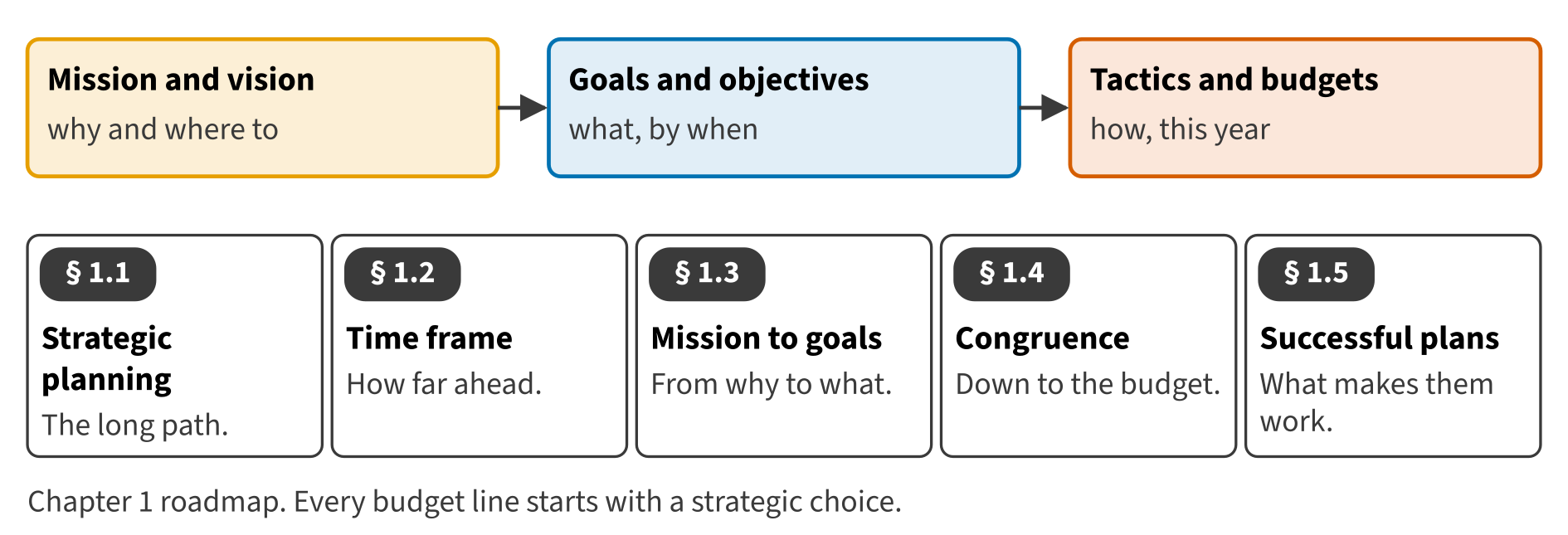
| LOS | Official statement (ICMA, 2024) | In plain words | Depth here |
|---|---|---|---|
| B.1.a | discuss how strategic planning determines the path an organization chooses for attaining its long-term goals, vision, and mission, and distinguish between vision and mission | Explain how strategic planning sets the path an organization follows to reach its long-term goals, vision and mission. | Full treatment |
| B.1.b | identify the time frame appropriate for a strategic plan | Choose a suitable time frame for a strategic plan. | Full treatment |
| B.1.e | demonstrate an understanding of how an organization’s mission leads to the formulation of long-term business objectives, such as business diversification, the addition or deletion of product lines, or the penetration of new markets | Show how the mission leads to long-term goals. | Full treatment + Extended Example |
| B.1.f | explain why short-term objectives, tactics for achieving these objectives, and operational planning (master budget) must be congruent with the strategic plan and contribute to the achievement of long-term strategic goals | Explain why short-term objectives, tactics and operational plans must fit the strategic plan. | Full treatment + Extended Example |
| B.1.g | identify the characteristics of successful strategic plans | Name the characteristics of successful strategic plans. | Full treatment |
The official statements are quoted from the ICMA Learning Outcome Statements (effective September 1, 2024). The plain-words column restates them in simpler English. The exam may test any outcome up to Level C.
What you already know
Book 2 built standard costs and budgets for single products. Book 3 shows how those budgets come from a company-wide plan, and how managers are judged against them.
The 8 key terms
Every scene has Check Answers and Try Again. Try Again reshuffles rather than revealing. When you are wrong, the first thing you read is the reason for the option you chose, taken from the book's own explanations. Progress is saved in this browser.