Part I · Strategy and budgeting foundations · Chapter 3
Budgeting Concepts: Roles, People and Behavior
مفاهيم الموازنة: الأدوار والأفراد والسلوك
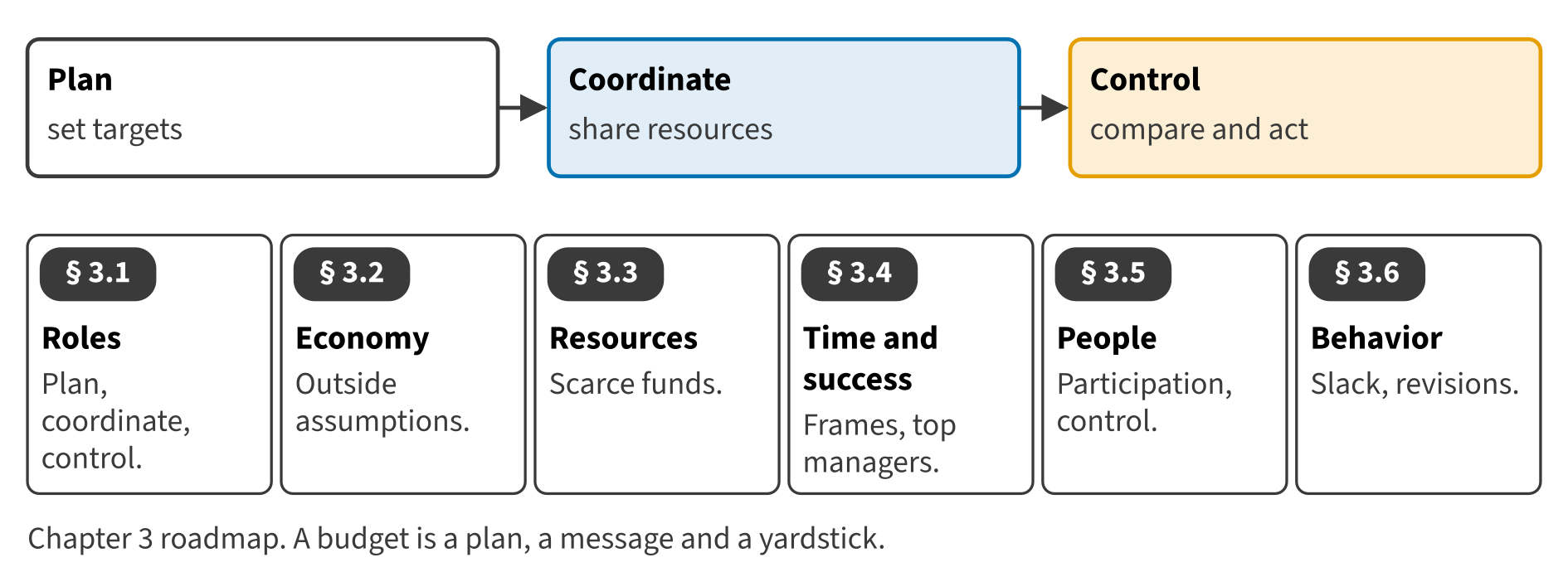
In September, the Beverages sales manager sent his first budget for 2028: 820,000 cases of juice. The controller's market data pointed to 900,000. The gap is not a mistake in arithmetic; it is about people, targets and bonuses. This chapter explains what budgets are for and how people shape them.
Start here
Then
What this chapter is tested on
| LOS | Official statement (ICMA, 2024) | In plain words | Depth here |
|---|---|---|---|
| B.2.a | describe the role that budgeting plays in the overall planning and performance evaluation process of an organization | Describe the role of budgeting in planning and in evaluating performance. | Full treatment |
| B.2.b | explain the interrelationships between economic conditions, industry situation, and an organization’s plans and budgets | Explain how economic conditions, the industry and the organization's plans and budgets affect each other. | Full treatment |
| B.2.c | identify the role that budgeting plays in formulating short-term objectives and in planning and controlling operations to meet those objectives | Identify the role of budgeting in setting short-term objectives and in planning and controlling operations. | Full treatment |
| B.2.d | demonstrate an understanding of the role that budgets play in measuring performance against established goals | Explain how budgets are used to measure performance against targets. | Full treatment |
| B.2.e | identify the characteristics that define successful budgeting processes | Name the characteristics of successful budgeting processes. | Full treatment |
| B.2.f | explain how the budgeting process facilitates communication among organizational units and enhances coordination of organizational activities | Explain how budgeting improves communication and coordination between units. | Full treatment |
| B.2.g | describe the concept of a controllable cost as it relates to both budgeting and performance evaluation | Describe controllable costs in budgeting and performance evaluation. | Full treatment |
| B.2.h | explain how the efficient allocation of organizational resources is planned during the budgeting process | Explain how the budget plans the efficient allocation of resources. | Full treatment |
| B.2.i | identify the appropriate time frame for various types of budgets | Name the right time frame for each type of budget. | Full treatment |
| B.2.j | identify who should participate in the budgeting process for optimum success | Identify who should take part in budgeting for the best results. | Full treatment |
| B.2.k | describe the role of top management in successful budgeting | Describe the role of top management in successful budgeting. | Full treatment |
| B.2.q | discuss the importance of a policy that allows budget revisions that accommodate the impact of significant changes in budget assumptions | Discuss why a policy for budget revisions is needed. | Full treatment |
| B.2.r | explain the role of budgets in monitoring and controlling expenditures to meet strategic objectives | Explain how budgets are used to monitor and control spending. | Full treatment |
| B.2.s | define budgetary slack and discuss its impact on goal congruence | Define budgetary slack and discuss its effect on goal congruence. | Full treatment + Extended Example |
The official statements are quoted from the ICMA Learning Outcome Statements (effective September 1, 2024). The plain-words column restates them in simpler English. The exam may test any outcome up to Level C.
What you already know
Chapter 1 set the strategic goals and Chapter 2 chose the strategies. Book 2 built the standard cost of a case of juice. The budget now turns all of these into next year's numbers.
The 9 key terms
Every scene has Check Answers and Try Again. Try Again reshuffles rather than revealing. When you are wrong, the first thing you read is the reason for the option you chose, taken from the book's own explanations. Progress is saved in this browser.