Part I · Strategy and budgeting foundations · Chapter 5
Budget Systems II: Zero-Based, Rolling and Flexible Budgets
أنظمة الموازنة (2): الموازنة الصفرية والموازنة المستمرة والموازنة المرنة
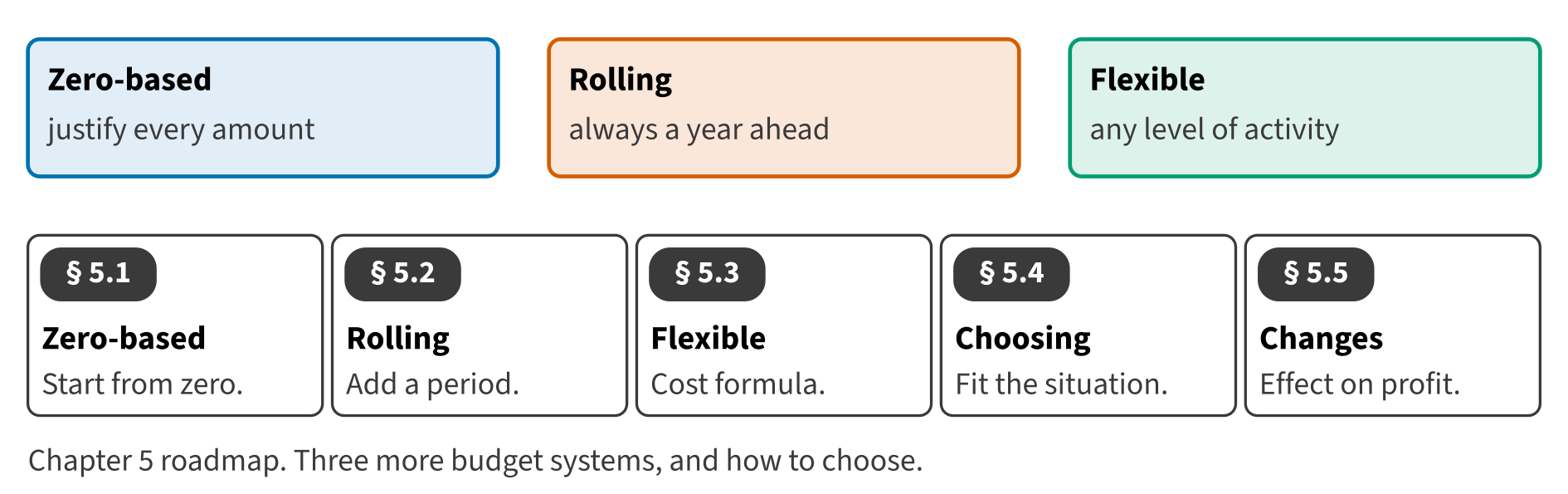
Head-office costs at Orontes have grown every year for five years, and nobody can say exactly why. The juice market changes every month, but the annual budget is fixed in December. And when Beverages sells fewer cases than planned, the plant manager is blamed for costs that fell with volume. This chapter shows three budget systems that deal with these problems.
Start here
Then
What this chapter is tested on
| LOS | Official statement (ICMA, 2024) | In plain words | Depth here |
|---|---|---|---|
| B.4.e | evaluate a business situation and recommend an appropriate budget solution | Evaluate a business situation and recommend a suitable budget system. | Full treatment + Extended Example |
| B.4.f | prepare budgets on the basis of information presented | Prepare zero-based, rolling and flexible budgets from the information given. | Full treatment + Extended Example |
| B.4.g | calculate the impact of incremental changes to budgets | Calculate the effect of changes, such as a new price or volume, on a budget. | Full treatment + Extended Example |
| B.4.a | define its purpose, appropriate use, and time frame | Define the purpose, use and time frame of zero-based, rolling and flexible budgets. | Introduced here for these systems (Chapter 4 for the others) |
| B.4.b | identify the budget components and explain the interrelationships among the components | Identify the components of these budgets and how they are linked. | Introduced here for these systems |
| B.4.c | demonstrate an understanding of how the budget is developed | Show how these budgets are developed. | Introduced here for these systems |
| B.4.d | compare the benefits and limitations of the budget system | Compare their benefits and limitations. | Introduced here for these systems |
The official statements are quoted from the ICMA Learning Outcome Statements (effective September 1, 2024). The plain-words column restates them in simpler English. The exam may test any outcome up to Level C.
What you already know
Chapter 4 compared an activity-based budget with last year plus a percentage. Book 2, Chapter 3 split costs into fixed and variable parts. Both ideas are used again here.
The 7 key terms
Every scene has Check Answers and Try Again. Try Again reshuffles rather than revealing. When you are wrong, the first thing you read is the reason for the option you chose, taken from the book's own explanations. Progress is saved in this browser.