Part III · Measuring and managing performance · Chapter 11
Performance Against the Budget: Flexible Budgets and Sales Variances
قياس الأداء مقابل الموازنة: الموازنات المرنة وانحرافات المبيعات
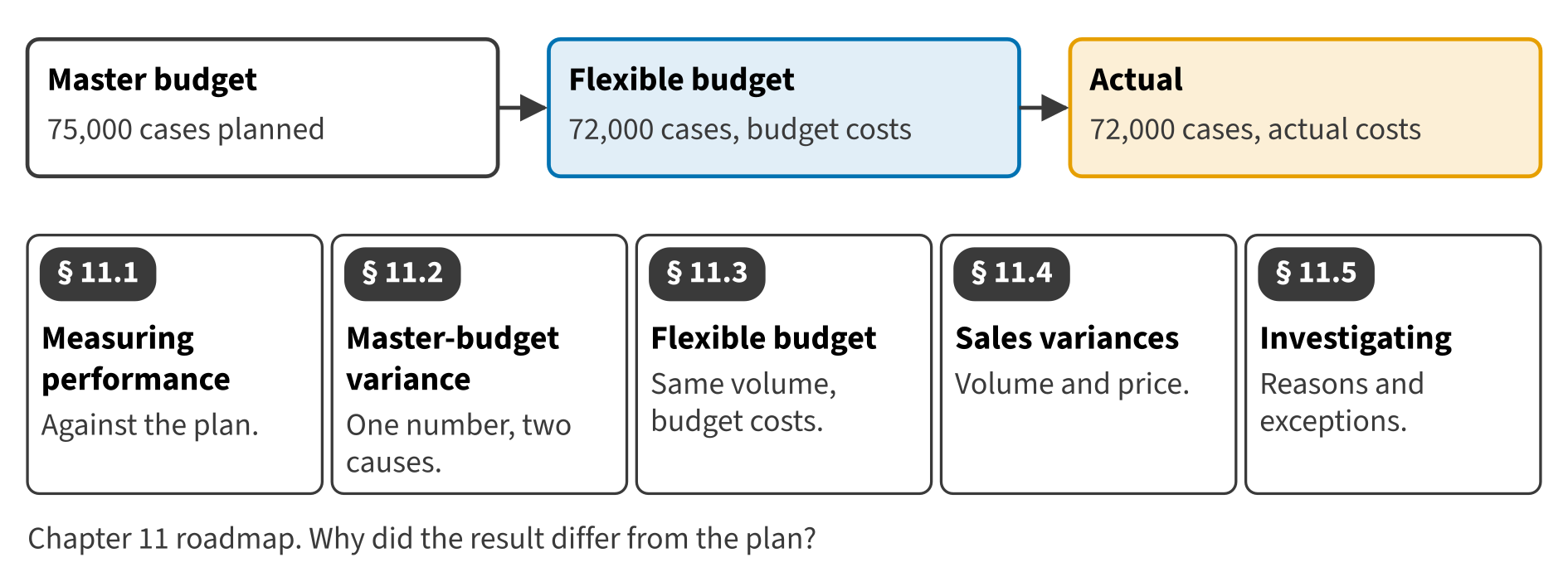
Part II planned the year. Part III now asks a harder question: when the results arrive, what do they tell us? In June 2028, Beverages planned 75,000 cases and an operating income of $265,000. It sold 72,000 cases and earned $247,632. This chapter explains how much of that gap came from volume, and how much from everything else.
Start here
Then
What this chapter is tested on
| LOS | Official statement (ICMA, 2024) | In plain words | Depth here |
|---|---|---|---|
| C.1.a | analyze performance against operational goals using measures based on revenue, manufacturing costs, nonmanufacturing costs, and profit depending on the type of center or unit being measured | Analyse performance against operational goals using measures of revenue, manufacturing costs, non-manufacturing costs and profit. | Full treatment |
| C.1.b | explain the reasons for variances within a performance monitoring system | Explain the reasons for variances in a performance monitoring system. | Full treatment |
| C.1.c | prepare a performance analysis by comparing actual results to the master budget, calculate favorable and unfavorable variances from the budget, and provide explanations for variances | Compare actual results with the master budget and calculate favorable and unfavorable variances. | Full treatment |
| C.1.d | identify and describe the benefits and limitations of measuring performance by comparing actual results to the master budget | Describe the benefits and limitations of measuring performance against the master budget. | Full treatment |
| C.1.e | analyze a flexible budget based on actual sales (output) volume | Analyse a flexible budget based on the actual sales volume. | Full treatment |
| C.1.f | calculate the sales-volume variance and the sales-price variance | Calculate the sales-volume variance and the sales-price variance. | Full treatment |
| C.1.g | calculate the flexible-budget variance by comparing actual results to the flexible budget | Calculate the flexible-budget variance by comparing actual results with the flexible budget. | Full treatment |
| C.1.h | investigate the flexible-budget variance to determine individual differences between actual and budgeted input prices and input quantities | Investigate the flexible-budget variance to find the differences in input prices and quantities. | Full treatment (calculations in Chapter 12) |
| C.1.i | explain how budget variance reporting is utilized in a management-by- exception environment | Explain how variance reporting is used in a management-by-exception environment. | Full treatment + Extended Example |
The official statements are quoted from the ICMA Learning Outcome Statements (effective September 1, 2024). The plain-words column restates them in simpler English. The exam may test any outcome up to Level C.
What you already know
Chapter 5 prepared flexible budgets at several volumes, and Chapter 8 built the operating budget. Book 2, Chapter 18 set the standard cost card that the budget costs come from.
The 6 key terms
Every scene has Check Answers and Try Again. Try Again reshuffles rather than revealing. When you are wrong, the first thing you read is the reason for the option you chose, taken from the book's own explanations. Progress is saved in this browser.