Part III · Measuring and managing performance · Chapter 15
Responsibility Centers, Contribution Reporting and Segments
مراكز المسؤولية وتقارير هامش المساهمة والقطاعات
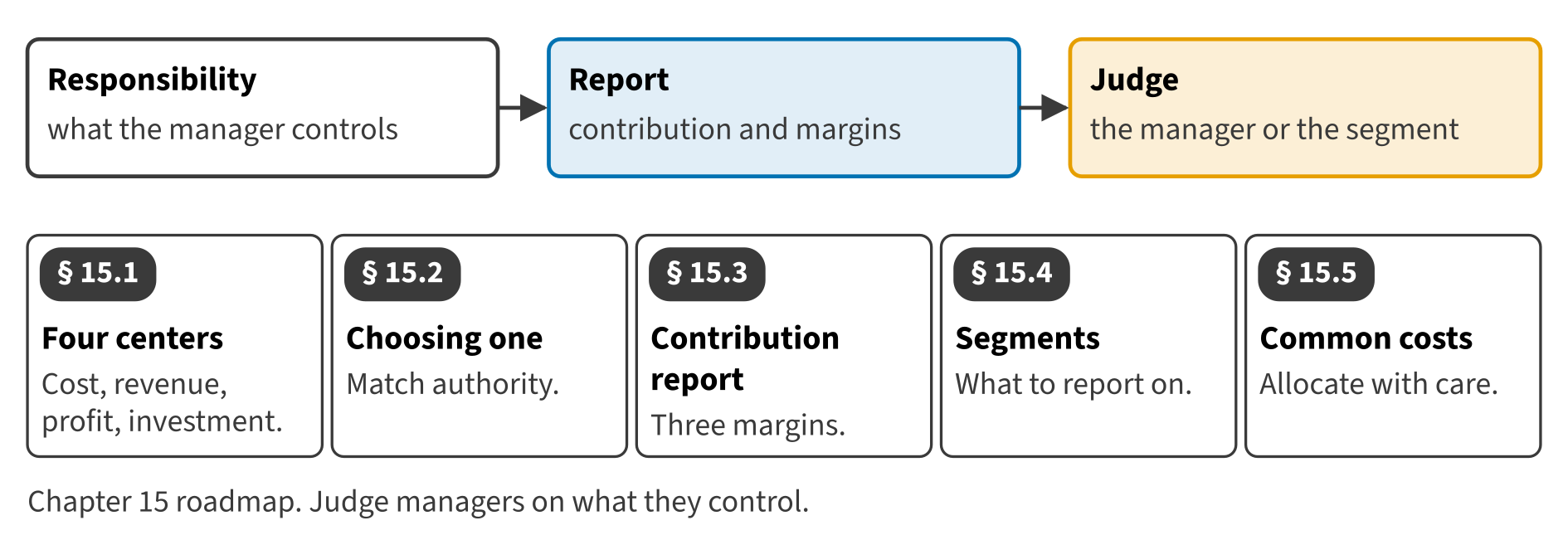
Chapters 11 to 14 measured what happened. This chapter asks a different question: who should answer for it? A plant manager who cannot set prices should not be judged on revenue, and a division charged a share of head office cannot make that charge go away. Good performance reporting starts by matching the measure to the authority.
Start here
Then
What this chapter is tested on
| LOS | Official statement (ICMA, 2024) | In plain words | Depth here |
|---|---|---|---|
| C.2.a | identify and explain the different types of responsibility centers | Identify and explain the different types of responsibility center. | Full treatment |
| C.2.b | recommend appropriate responsibility centers given a business scenario | Recommend a suitable responsibility center for a given business situation. | Full treatment |
| C.2.c | calculate a contribution margin | Calculate a contribution margin. | Full treatment |
| C.2.d | analyze a contribution margin report and evaluate performance | Analyse a contribution margin report and evaluate performance. | Full treatment + Extended Example |
| C.2.e | identify segments that organizations evaluate, including product lines, geographical areas, or other meaningful segments | Identify the segments organizations evaluate, such as product lines and geographical areas. | Full treatment |
| C.2.f | explain why the allocation of common costs among segments can be an issue in performance evaluation | Explain why allocating common costs among segments is a problem in performance evaluation. | Full treatment + Extended Example |
| C.2.g | identify methods for allocating common costs such as stand-alone cost allocation and incremental cost allocation | Identify methods of allocating common costs, including stand-alone and incremental allocation. | Full treatment |
The official statements are quoted from the ICMA Learning Outcome Statements (effective September 1, 2024). The plain-words column restates them in simpler English. The exam may test any outcome up to Level C.
What you already know
Book 2, Chapter 13 measured customer and product profitability, and Chapter 3 of this book discussed participation and controllability in budgeting. Chapter 8 produced the figures this chapter now splits by segment.
The 9 key terms
Every scene has Check Answers and Try Again. Try Again reshuffles rather than revealing. When you are wrong, the first thing you read is the reason for the option you chose, taken from the book's own explanations. Progress is saved in this browser.