Part I · Internal controls · Chapter 5
COSO, Risk Types, Testing and Remediation
إطار كوزو وأنواع المخاطر والاختبار والمعالجة
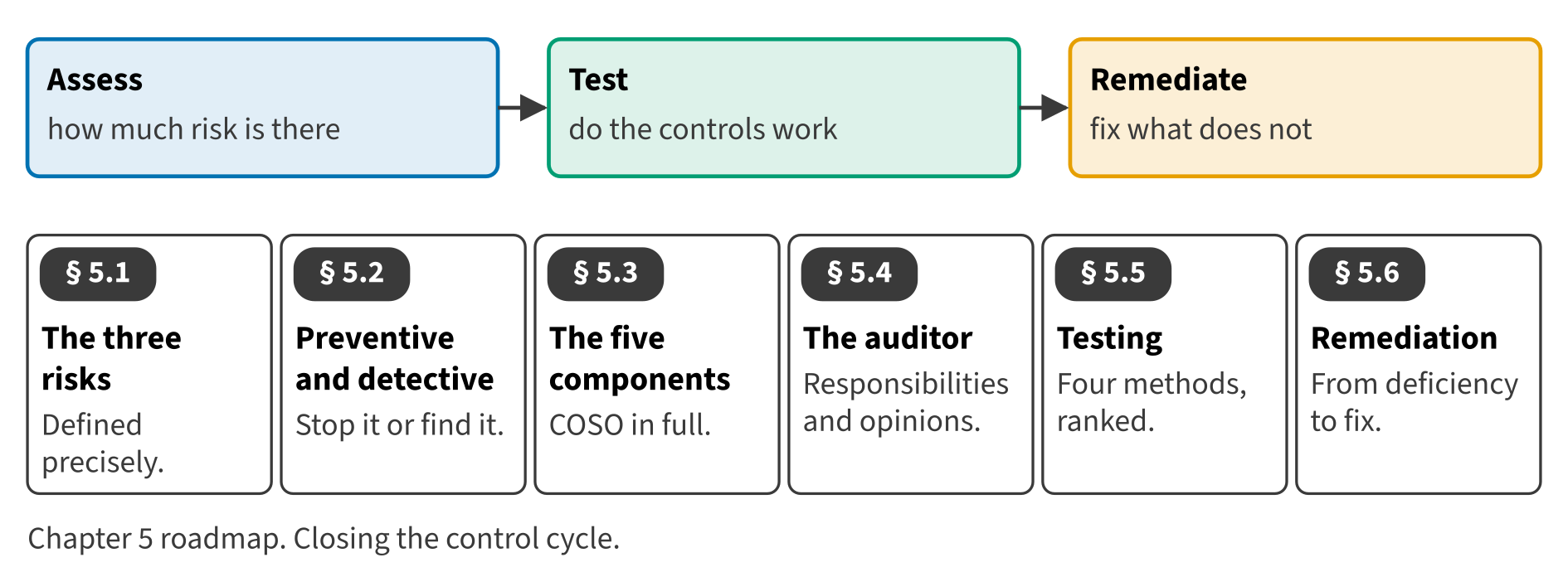
This chapter closes the loop that Chapter 1 opened. It defines the three risks precisely, sets out the framework in full, and then follows a deficiency from the moment it is found to the moment it can honestly be called fixed.
Start here
Then
What this chapter is tested on
| LOS | Official statement (ICMA, 2024) | In plain words | Depth here |
|---|---|---|---|
| E.1.n | define inherent risk, control risk, and detection risk | Define inherent risk, control risk and detection risk. | Full treatment |
| E.1.o | define and distinguish between preventive controls and detective controls | Define and distinguish between preventive and detective controls. | Full treatment |
| E.1.u | identify and describe the five major components of COSO’s Internal Control— Integrated Framework | Identify and describe the five components of the COSO Internal Control framework. | Full treatment |
| E.1.v | assess the level of internal control risk within an organization and recommend risk mitigation strategies | Assess the level of internal control risk in an organization and recommend mitigation strategies. | Full treatment + Extended Example |
| E.1.w | demonstrate an understanding of external auditor responsibilities, including the types of audit opinions that external auditors issue | Demonstrate an understanding of external auditor responsibilities, including the types of opinion. | Full treatment |
| E.1.x | identify and explain methods for testing the adequacy of internal controls, including inquiry, observation, inspection, and re-performance | Identify and explain the methods for testing internal controls. | Full treatment |
| E.1.y | explain how to remediate internal control deficiencies | Explain how to remediate internal control deficiencies. | Full treatment + Extended Example |
The official statements are quoted from the ICMA Learning Outcome Statements (effective September 1, 2024). The plain-words column restates them in simpler English. The exam may test any outcome up to Level C.
What you already know
Chapter 1 used the three risks to explain what control risk is, and Chapter 4 described the top-down approach the auditor follows. This chapter defines the risks formally and takes the testing further.
The 8 key terms
Every scene has Check Answers and Try Again. Try Again reshuffles rather than revealing. When you are wrong, the first thing you read is the reason for the option you chose, taken from the book's own explanations. Progress is saved in this browser.