Part III · Information systems · Chapter 10
ERP, Databases and Enterprise Performance Management
تخطيط موارد المؤسسة وقواعد البيانات وإدارة الأداء
Chapter 9 ended with a question nobody at Orontes could answer cheaply: what did one case of oil cost, and why. This chapter answers it, and then asks what a company does with the answer once it has it.
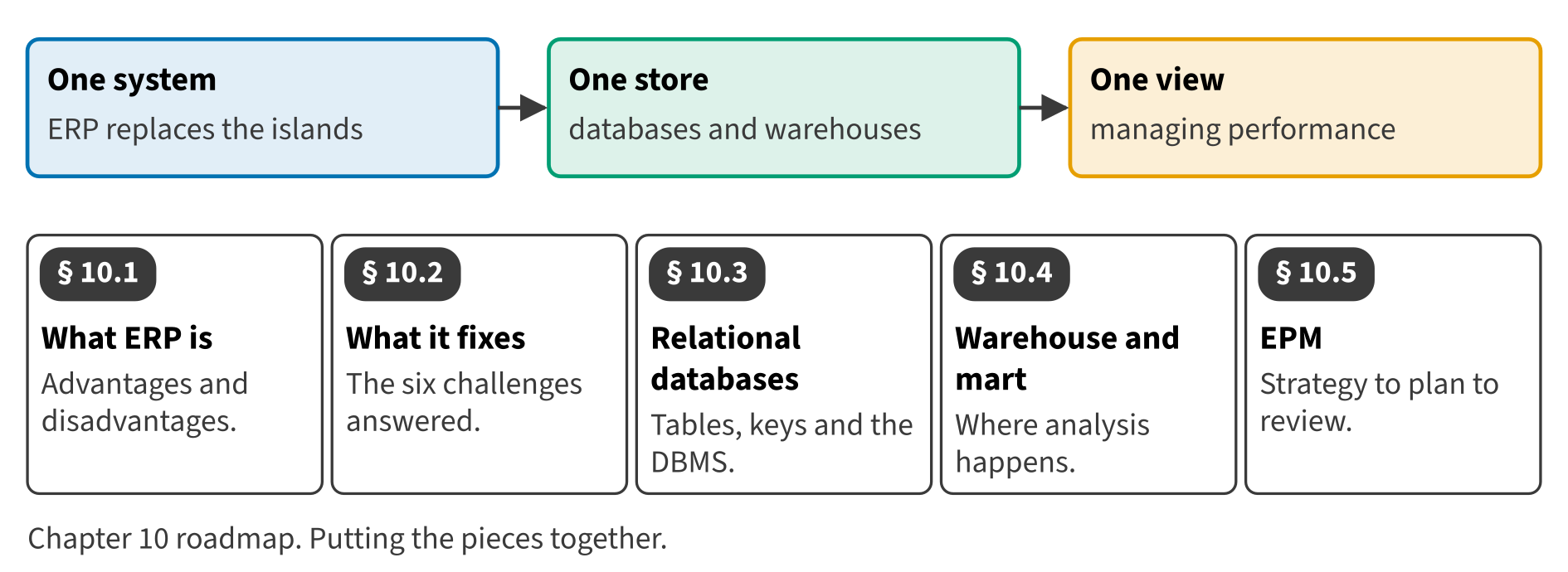
Start here
Then
What this chapter is tested on
| LOS | Official statement (ICMA, 2024) | In plain words | Depth here |
|---|---|---|---|
| F.1.d | define ERP and identify and explain the advantages and disadvantages of ERP | Define ERP and identify and explain its advantages and disadvantages. | Full treatment |
| F.1.e | explain how ERP helps overcome the challenges of separate financial and nonfinancial systems, integrating all aspects of an organization’s activities | Explain how ERP helps overcome the challenges of separate financial and nonfinancial systems. | Full treatment |
| F.1.f | define relational database and demonstrate an understanding of a database management system | Define a relational database and demonstrate an understanding of a database management system. | Full treatment |
| F.1.g | define data warehouse and data mart | Define data warehouse and data mart. | Full treatment |
| F.1.h | define enterprise performance management (EPM) (also known as corporate performance management (CPM) or business performance management (BPM)) | Define enterprise performance management, also known as corporate or business performance management. | Full treatment |
| F.1.i | discuss how EPM can facilitate business planning and performance management | Discuss how enterprise performance management can facilitate business planning and performance management. | Full treatment + Extended Example |
The official statements are quoted from the ICMA Learning Outcome Statements (effective September 1, 2024). The plain-words column restates them in simpler English. The exam may test any outcome up to Level C.
What you already know
Chapter 9 listed six challenges of keeping systems separate. This chapter takes them one at a time and shows what an integrated system does about each, so Figure F409-05 is worth rereading first.
The 11 key terms
Every scene has Check Answers and Try Again. Try Again reshuffles rather than revealing. When you are wrong, the first thing you read is the reason for the option you chose, taken from the book's own explanations. Progress is saved in this browser.