Part III · Information systems · Chapter 11
Data Governance, the Data Life Cycle and Cyber Controls
حوكمة البيانات ودورة حياة البيانات وضوابط الأمن السيبراني
Chapter 10 put every fact in one place. That makes the next question unavoidable: who decides what may be done with it, how long it is kept, and who is answerable when it is wrong or stolen.
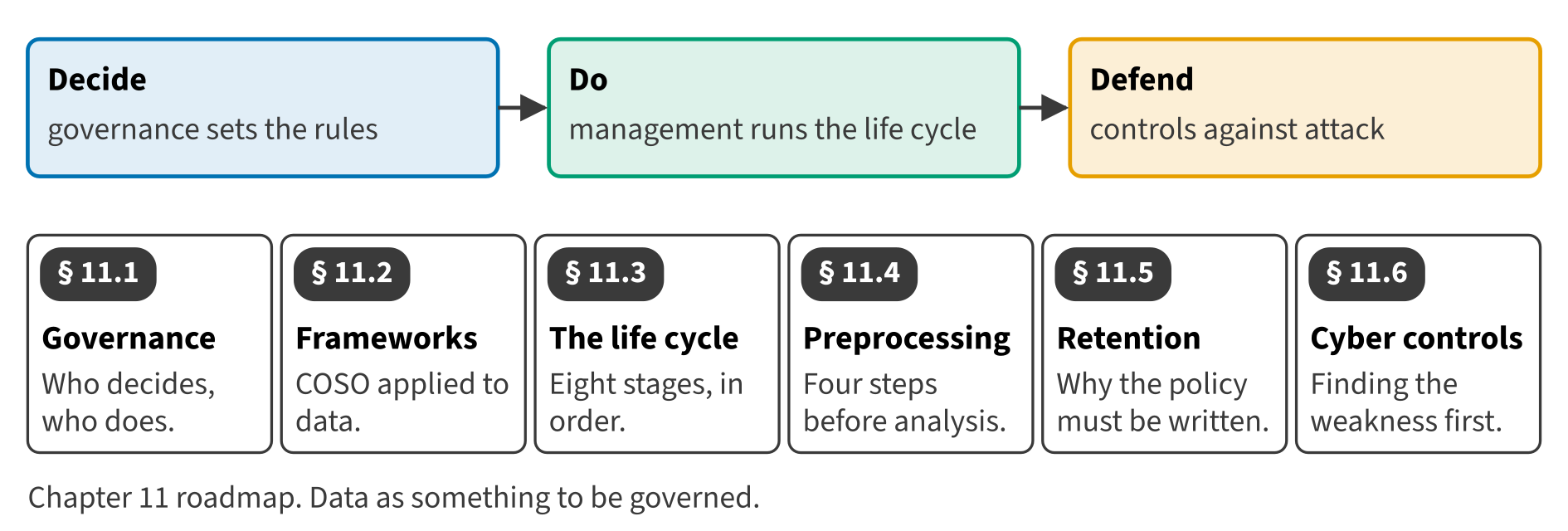
Start here
Then
What this chapter is tested on
| LOS | Official statement (ICMA, 2024) | In plain words | Depth here |
|---|---|---|---|
| F.2.a | define data governance and data management | Define data governance and data management. | Full treatment |
| F.2.b | demonstrate a general understanding of data governance frameworks, including COSO’s Internal Control—Integrated framework | Demonstrate a general understanding of data governance frameworks, including COSO's Internal Control-Integrated Framework. | Full treatment |
| F.2.c | identify the stages of the data life cycle, i.e., data capture, data maintenance, data synthesis, data usage, data analytics, data publication, data archival, and data purging | Identify the stages of the data life cycle. | Full treatment |
| F.2.d | demonstrate an understanding of data preprocessing and the steps to convert data for further analysis, including data consolidation, data cleaning (cleansing), data transformation, and data reduction | Demonstrate an understanding of data preprocessing: consolidation, cleaning, transformation and reduction. | Full treatment + Extended Example |
| F.2.e | discuss the importance of having a documented record retention (or records management) policy | Discuss the importance of having a documented record retention policy. | Full treatment + Extended Example |
| F.2.f | identify and explain controls and tools to detect and thwart cyberattacks, such as penetration and vulnerability testing, biometrics, advanced firewalls, and access controls | Identify and explain controls and tools to detect and thwart cyberattacks. | Full treatment |
The official statements are quoted from the ICMA Learning Outcome Statements (effective September 1, 2024). The plain-words column restates them in simpler English. The exam may test any outcome up to Level C.
What you already know
Chapter 1 defined the control environment as deciding who answers for what. This chapter applies that idea to a particular asset, and Chapter 6's access controls reappear here as part of the defence against attack.
The 17 key terms
Every scene has Check Answers and Try Again. Try Again reshuffles rather than revealing. When you are wrong, the first thing you read is the reason for the option you chose, taken from the book's own explanations. Progress is saved in this browser.