Part IV · Data analytics · Chapter 13
Big Data and Business Intelligence
البيانات الضخمة وذكاء الأعمال
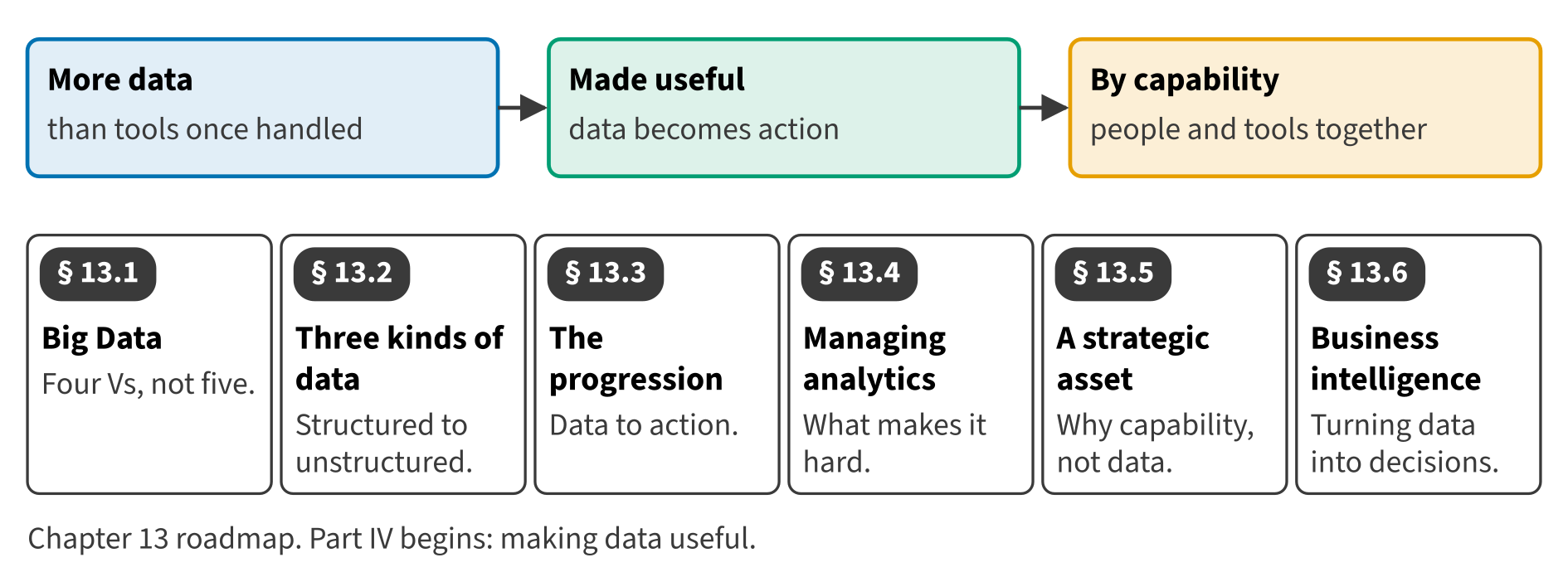
Part IV is about getting answers out of data. It opens here with what the data is and why there is suddenly so much of it, and ends five chapters later with how to present an answer without misleading anybody.
Start here
Then
What this chapter is tested on
| LOS | Official statement (ICMA, 2024) | In plain words | Depth here |
|---|---|---|---|
| F.4.a | define Big Data and explain the volume, velocity, variety, and veracity of Big Data; and describe the opportunities and challenges of leveraging insight from this data | Define Big Data and explain volume, velocity, variety and veracity, with the opportunities and challenges of using it. | Full treatment |
| F.4.b | explain how structured, semi-structured, and unstructured data is used by a business enterprise | Explain how structured, semi-structured and unstructured data are used by a business. | Full treatment |
| F.4.c | describe the progression of data, from data to information to knowledge to insight to action | Describe the progression from data to information to knowledge to insight to action. | Full treatment + Extended Example |
| F.4.d | describe the opportunities and challenges of managing data analytics | Describe the opportunities and challenges of managing data analytics. | Full treatment |
| F.4.e | explain why data and data science capability are strategic assets | Explain why data and data science capability are strategic assets. | Full treatment |
| F.4.f | define business intelligence (BI) (i.e., the collection of applications, tools, and best practices that transform data into actionable information in order to make better decisions and optimize performance) | Define business intelligence. | Full treatment |
The official statements are quoted from the ICMA Learning Outcome Statements (effective September 1, 2024). The plain-words column restates them in simpler English. The exam may test any outcome up to Level C.
What you already know
Chapter 11 took one dataset through preprocessing, and Chapter 10 put it in a warehouse for analysis. This part now asks what the analysis itself can find, using the Beverages demand data that Book 3 budgeted.
The 8 key terms
Every scene has Check Answers and Try Again. Try Again reshuffles rather than revealing. When you are wrong, the first thing you read is the reason for the option you chose, taken from the book's own explanations. Progress is saved in this browser.