Part IV · Data analytics · Chapter 15
Types of Analytics and Regression
أنواع التحليلات وتحليل الانحدار
Chapter 14 left a hypothesis untested: that Beverages demand follows temperature more closely than the promotion calendar. This chapter tests it, and in doing so covers the one calculation in this part of the syllabus.
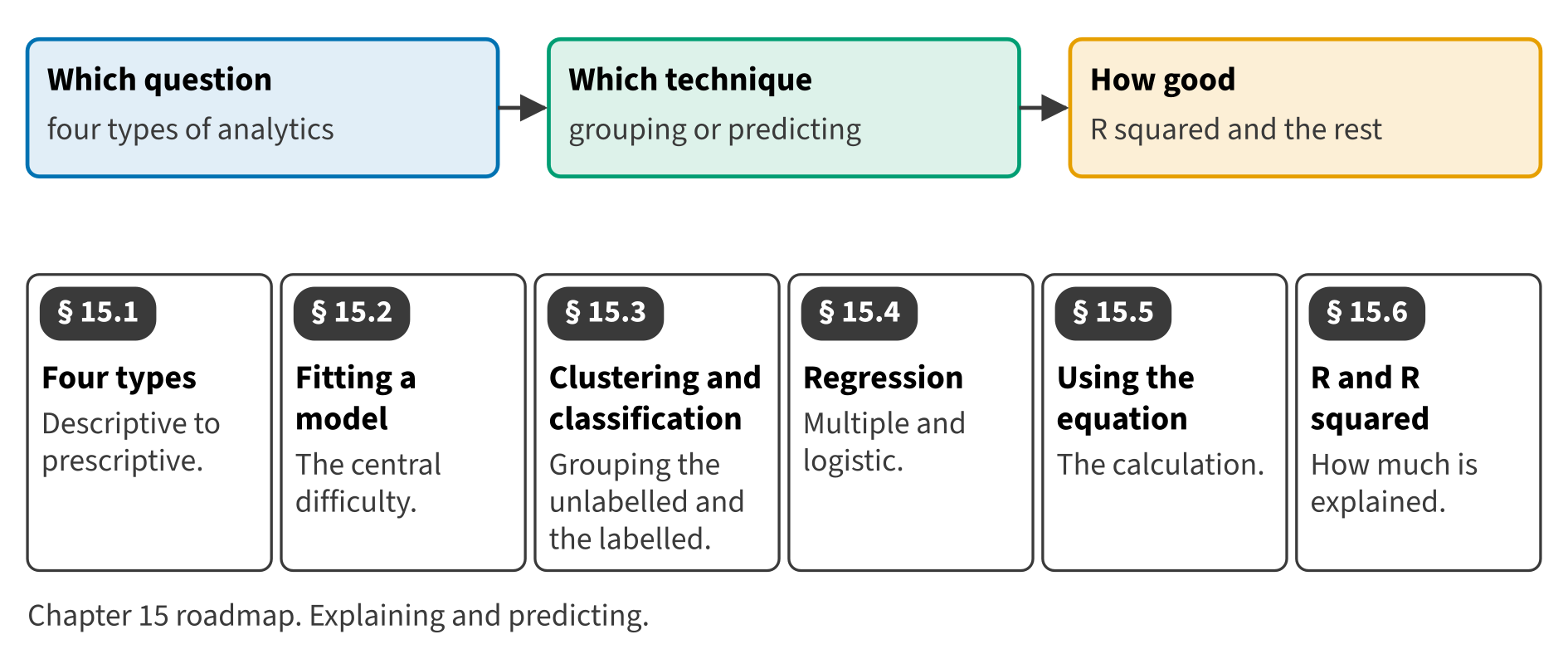
Start here
Then
What this chapter is tested on
| LOS | Official statement (ICMA, 2024) | In plain words | Depth here |
|---|---|---|---|
| F.4.l | explain the challenge of fitting an analytics model to the data | Explain the challenge of fitting an analytics model to the data. | Full treatment |
| F.4.m | define the different types of data analytics, including descriptive, diagnostic, predictive, and prescriptive | Define descriptive, diagnostic, predictive and prescriptive analytics. | Full treatment |
| F.4.n | define clustering and classification, and determine when each of these analytic techniques would be the appropriate tool to use | Define clustering and classification and determine when each is the appropriate tool. | Full treatment |
| F.4.o | demonstrate an understanding of multiple regression and logistic regression and recognize when these techniques are appropriate | Demonstrate an understanding of multiple and logistic regression and when each is appropriate. | Full treatment |
| F.4.p | calculate the result of multiple regression equations as applied to a specific situation | Calculate the result of a multiple regression equation applied to a situation. | Full treatment + Extended Example |
| F.4.q | demonstrate an understanding of the coefficient of determination (R squared) and the correlation coefficient (R) | Demonstrate an understanding of the coefficient of determination and the correlation coefficient. | Full treatment |
The official statements are quoted from the ICMA Learning Outcome Statements (effective September 1, 2024). The plain-words column restates them in simpler English. The exam may test any outcome up to Level C.
What you already know
Book 2 used the high-low method to split a mixed cost into fixed and variable parts. Regression does the same job properly, using every observation rather than two, and this chapter is where that promise is kept.
The 14 key terms
Every scene has Check Answers and Try Again. Try Again reshuffles rather than revealing. When you are wrong, the first thing you read is the reason for the option you chose, taken from the book's own explanations. Progress is saved in this browser.