Part IV · Data analytics · Chapter 17
Simulation, Sensitivity and Expected Value
المحاكاة وتحليل الحساسية والقيمة المتوقعة
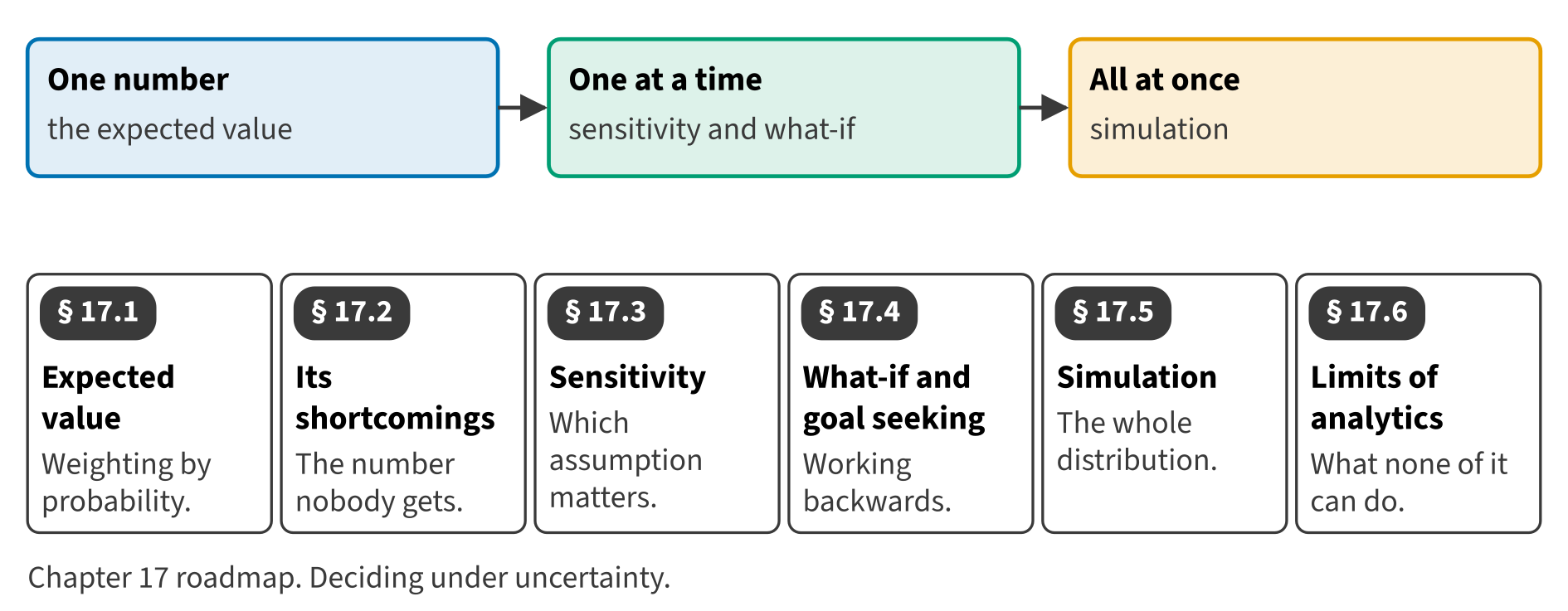
Chapters 15 and 16 produced a single predicted number. This chapter asks what to do with the uncertainty around it, which is the question a board actually faces.
Start here
Then
What this chapter is tested on
| LOS | Official statement (ICMA, 2024) | In plain words | Depth here |
|---|---|---|---|
| B.3.g | calculate the expected value of random variables | Calculate the expected value of random variables. | Full treatment + Extended Example |
| B.3.h | identify the benefits and shortcomings of the expected value technique | Identify the benefits and shortcomings of the expected value technique. | Full treatment |
| B.3.i | use probability values to estimate future cash flows | Use probability values to estimate future cash flows. | Full treatment |
| F.4.w | define sensitivity analysis and identify when it would be the appropriate tool to use | Define sensitivity analysis and identify when it is the appropriate tool. | Full treatment |
| F.4.z | demonstrate an understanding of what-if (or goal-seeking) analysis | Demonstrate an understanding of what-if and goal-seeking analysis. | Full treatment |
| F.4.x | demonstrate an understanding of the uses of simulation models, including the Monte Carlo technique | Demonstrate an understanding of simulation models, including the Monte Carlo technique. | Full treatment + Extended Example |
| F.4.y | identify the benefits and limitations of sensitivity analysis and simulation models | Identify the benefits and limitations of sensitivity analysis and simulation models. | Full treatment |
| F.4.u | explain how to use predictive analytics techniques to draw insights and make recommendations | Explain how to use predictive analytics to draw insights and make recommendations. | Full treatment |
| F.4.aa | identify and explain the limitations of data analytics | Identify and explain the limitations of data analytics. | Full treatment |
The official statements are quoted from the ICMA Learning Outcome Statements (effective September 1, 2024). The plain-words column restates them in simpler English. The exam may test any outcome up to Level C.
What you already know
Book 3 budgeted the Gulf expansion on one set of assumptions. This chapter takes that same project and asks what happens when the assumptions move, which is why three of its outcomes come from Section B rather than Section F.
The 7 key terms
Every scene has Check Answers and Try Again. Try Again reshuffles rather than revealing. When you are wrong, the first thing you read is the reason for the option you chose, taken from the book's own explanations. Progress is saved in this browser.