Part IV · Data analytics · Chapter 18
Data Visualization
العرض المرئي للبيانات
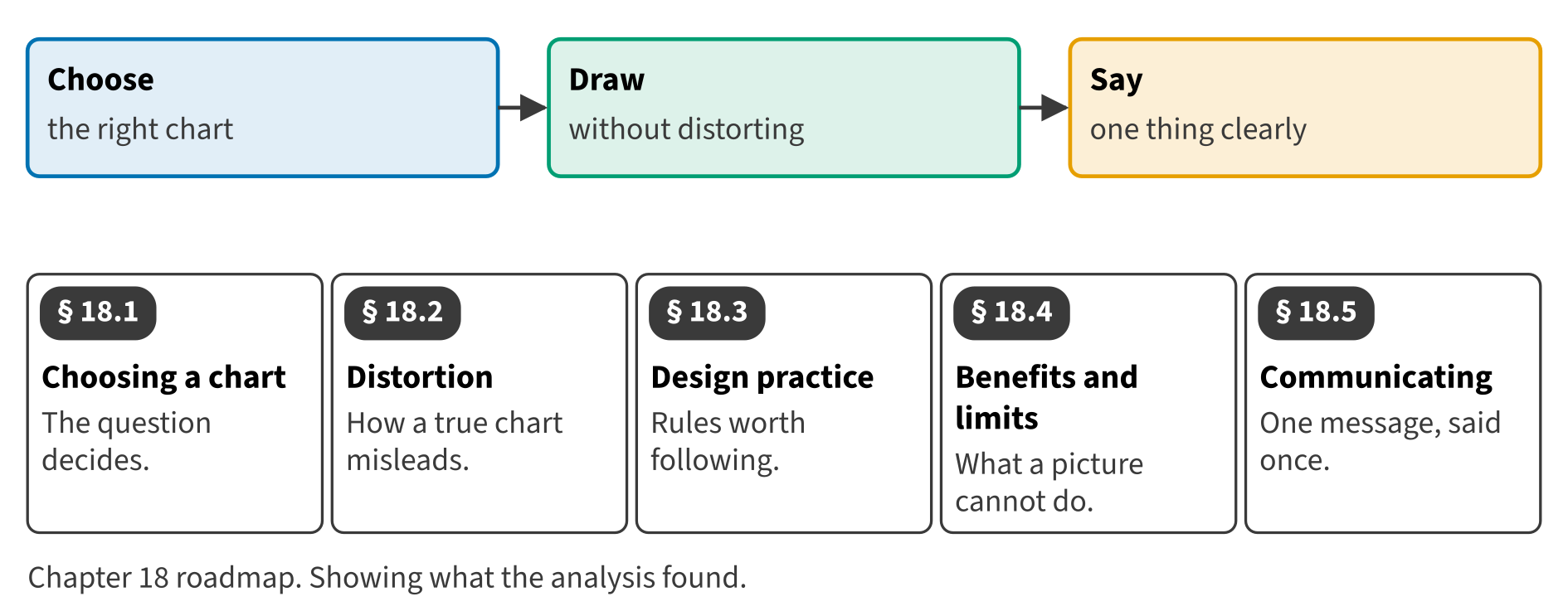
Everything in Part IV has produced an answer. This chapter is about the last step, which decides whether anybody acts on it: showing the answer to someone who was not part of the analysis.
Start here
Then
What this chapter is tested on
| LOS | Official statement (ICMA, 2024) | In plain words | Depth here |
|---|---|---|---|
| F.4.cc | evaluate data visualization options and select the best presentation approach (e.g., histograms, box plots, scatterplots, dot plots, tables, dashboards, bar charts, pie charts, line charts, bubble charts) for a given scenario | Evaluate data visualization options and select the best presentation approach. | Full treatment + Extended Example |
| F.4.bb | utilize table and graph design best practices to avoid distortion in the communication of complex information | Use table and graph design best practices to avoid distortion when communicating complex information. | Full treatment |
| F.4.dd | understand the benefits and limitations of visualization techniques | Understand the benefits and limitations of visualization techniques. | Full treatment |
| F.4.ee | communicate results, conclusions, and recommendations in an impactful manner using effective visualization techniques | Communicate results, conclusions and recommendations impactfully using effective visualization. | Full treatment + Extended Example |
The official statements are quoted from the ICMA Learning Outcome Statements (effective September 1, 2024). The plain-words column restates them in simpler English. The exam may test any outcome up to Level C.
What you already know
Every figure in this book is an example of what this chapter teaches. The scatter plot of Chapter 15, the decomposition of Chapter 16 and the histogram of Chapter 17 were each chosen for the question they had to answer. This chapter makes that choice explicit.
The 6 key terms
Every scene has Check Answers and Try Again. Try Again reshuffles rather than revealing. When you are wrong, the first thing you read is the reason for the option you chose, taken from the book's own explanations. Progress is saved in this browser.